



Medical writing teams face an uncomfortable pair of facts. Generative AI demonstrably accelerates drafting, and generative AI confidently produces errors that look like finished work. In most industries, that tradeoff is a quality nuisance. In regulated medical content, where a fabricated citation or an unsupported claim can surface in a regulatory review or, worse, in front of a health authority, it is a governance problem that deserves the same rigor as any other quality system.
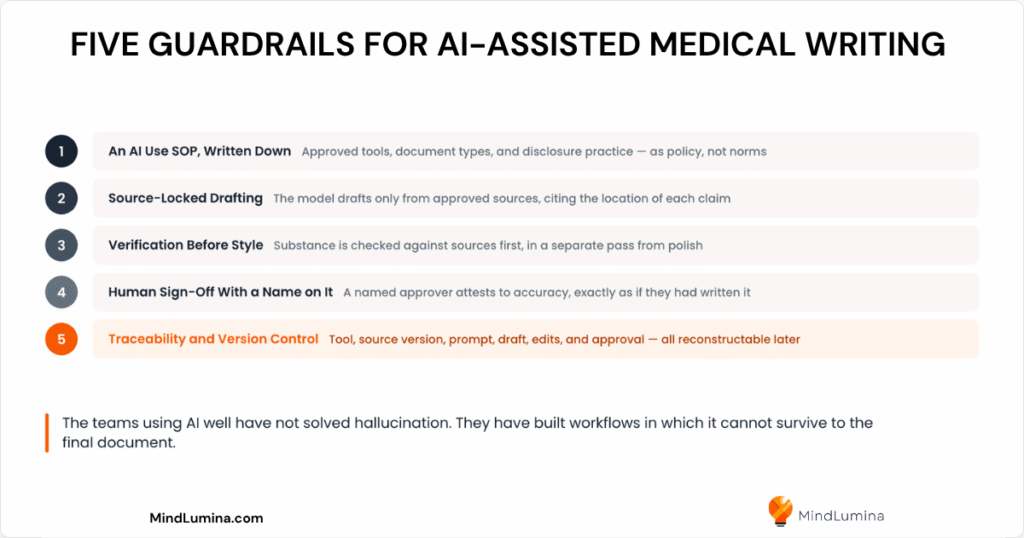
The teams using AI well have not solved hallucination. They have built workflows in which hallucination cannot survive to the final document. Five guardrails do most of the work.
Guardrail 1: An AI Use SOP, Written Down
The first control is the least technical: a standard operating procedure stating which document types may involve AI assistance, which may not, which tools are approved, and who owns final review. Unwritten norms drift; written SOPs get followed and verified. The SOP should also define disclosure practice, meaning whether and how AI assistance is recorded for each document type. When a regulator asks how AI is used in your writing process, the correct answer is a document, not a description.
Guardrail 2: Source-Locked Drafting
The highest-risk AI writing pattern is open-ended generation, where the model drafts from its own training rather than from your evidence. The safer pattern is source-locked: the model receives the approved source documents (the protocol, the clinical study report, the reference library) and is instructed to draft only from them, citing the location of each supported statement. Those source documents are themselves increasingly AI-assisted artifacts, which makes the version discipline in Guardrail 5 matter more, not less. Modern models handle this pattern well, and it converts verification from detective work into checking.
Guardrail 3: Verification Before Style
Review AI-assisted drafts in two separate passes, in a fixed order. Pass one verifies substance: every claim traced to a source, every citation opened and confirmed, every number checked against the tables. Pass two addresses style, flow, and format. Teams that combine the passes consistently find that polished language lulls reviewers into skimming substance. A fabricated reference reads exactly as smoothly as a real one; that is the danger.
Guardrail 4: Human Sign-Off With a Name on It
Every AI-assisted document should carry a named human approver who attests to its accuracy, exactly as if they had written it. Accountability that stays with a person changes reviewer behavior, and it aligns with how health authorities and legal teams think about responsibility. The model is a tool; the signature is human.
Guardrail 5: Traceability and Version Control
Keep the chain: which tool, which version of the source library, which prompt or workflow, which draft, whose edits, whose approval. Document management systems already handle most of this for human writing; the discipline is extending the same rigor to AI-assisted steps rather than letting them happen in an untracked chat window. If a question arises a year later, the team should be able to reconstruct how the document came to say what it says.
What This Looks Like in Practice
A representative compliant workflow for a standard response letter: the writer assembles the approved evidence set, an AI agent drafts strictly from that set with location-level citations, the writer runs the verification pass against sources, a second reviewer runs the style and format pass, medical review approves with a named signature, and the document system records every step. The AI removed hours from the drafting stage. It removed nothing from accountability.
How AI in Medical Writing is Evolving
Expect two developments to raise the bar. First, verification itself is becoming agentic: models checking a draft’s claims against sources and flagging unsupported statements before any human reads it. Second, health authority expectations are converging on documented, risk-based AI governance. The FDA’s first draft guidance on AI in drug and biologic regulation proposes a risk-based credibility assessment framework built around defining an AI model’s context of use and documenting the evidence that it is fit for that use. Teams that build these guardrails now are not just avoiding risk. They are building the documented process that will soon be table stakes.
Frequently Asked Questions (FAQs)
Can AI be used for regulated medical writing?
Yes, with controls. Compliant programs typically use source-locked drafting from approved evidence, mandatory human verification of every claim and citation, named human sign-off, and a complete traceable record of every step, all defined in a written SOP.
What is the biggest risk of AI in medical writing?
Confident fabrication: statements or citations that look correct but are not supported by the source evidence. The risk is managed by drafting only from supplied sources and verifying substance before style in review.
Should AI assistance be disclosed in medical documents?
Practice varies by document type and company policy. What matters most is that the organization’s SOP defines the disclosure standard and that it is applied consistently, so the answer to an external question is documented rather than improvised.