

With over 3,000 presentations at major medical conferences like ASCO, the traditional conference experience forces attendees to make snap decisions about which sessions to attend, often based on limited information in program guides. Many end up missing breakthrough research directly relevant to their practice while sitting through presentations that offer little practical value. AI personalization solves this problem by using smart algorithms to create experiences that match each attendee’s professional needs and interests.
The Scale of the Information Overload Problem
Modern medical conferences have grown exponentially in both size and complexity. Major healthcare conferences now attract tens of thousands of attendees and feature hundreds of exhibitors across multiple specialty pavilions. Healthcare professionals face an impossible choice: which 10-15 sessions should they attend out of hundreds of available options?
Traditional browsing methods simply don’t work at this scale. Attendees rely on conference program guides with limited session descriptions, word-of-mouth recommendations from colleagues, random exploration of the exhibit hall, and last-minute scheduling decisions based on proximity.
How AI Personalization Technology Works
AI turns overwhelming conference programs into personalized learning experiences through smart data analysis and intelligent matching.
The system starts by analyzing attendee profiles (e.g., specialty, research interests, career stage, and past conference behavior). Machine learning algorithms then match these preferences with session content, speaker expertise, and networking opportunities.
Smart features include:
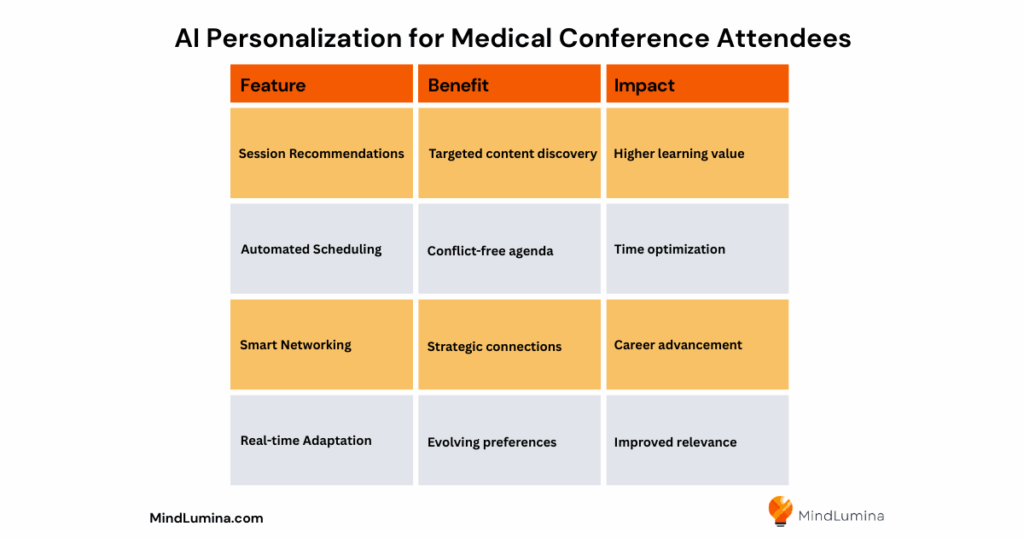
- Personalized session recommendations based on professional background and interests
- Automated scheduling that avoids conflicts while prioritizing high-value content
- Intelligent networking connecting attendees with compatible research focus
- Real-time adaptation that adjusts recommendations based on conference behavior
Mobile apps deliver these capabilities seamlessly. Attendees receive customized dashboards with session suggestions, smart notifications, and networking recommendations —all updated continuously as preferences become clearer throughout the event.
From Recommendations to Autonomous Agents
The personalization features described above are evolving into something more autonomous. Rather than surfacing a ranked list of sessions and letting the attendee decide, agentic conference tools now act on an attendee’s behalf: initiating introductions, adjusting schedules in real time, and answering logistics questions without the attendee opening an app and searching.
ATIV Software’s EventPilot platform, used widely across scientific and medical meetings, launched MeetingMates in April 2026, an AI-powered matchmaking feature purpose-built for medical and scientific conferences that surfaces relevant connections based on shared sessions and research interests without manual searching. Outside medicine, general-purpose event-concierge agents have moved from pilot to production quickly. At HumanX 2026, a suite of networking agents reportedly drove roughly 150,000 attendee matches at a single event.
This shift raises a fair question alongside the convenience: matchmaking agents that build recommendations from professional profiles and behavioral data need transparent disclosure of what data feeds the match and how attendees can opt out, a consideration worth raising with any vendor evaluating these tools for a medical or scientific meeting.
Proven Benefits for Healthcare Professionals
AI personalization improves every aspect of the conference experience, delivering measurable value for attendees seeking to maximize their professional development.
Targeted content discovery represents the most immediate benefit. Instead of wandering exhibit halls or randomly selecting sessions, healthcare professionals receive curated recommendations that align precisely with their clinical focus and research interests.
Efficient networking converts chance encounters into strategic professional connections. These curated session recommendations can greatly increase session participation, audience engagement, and feedback scores by ensuring the right people attend the right session. AI technology can identify attendees with complementary expertise, facilitating collaborations that might never have occurred through traditional networking approaches.
Time optimization addresses one of the most common conference frustrations. Automated scheduling and intelligent recommendations reduce decision fatigue while maximizing learning opportunities. Attendees can focus on absorbing valuable information rather than constantly second-guessing their session choices.
Career development gains momentum through more strategic conference experiences. Early-career professionals receive recommendations for mentorship opportunities and career-focused sessions, while established practitioners discover emerging research areas that could expand their expertise or patient care capabilities. Post-conference, AI technology continues providing personalized content recommendations and networking suggestions to maintain professional momentum.
AI personalization helps healthcare professionals maximize the value of their limited conference time. As medical knowledge continues expanding at an exponential rate, intelligent AI systems can effectively match attendees with relevant content by understanding individual professional needs and learning goals.